The $1.3 Trillion Vote: Five Surprising Realities Behind the “Trump Dividend”
The despair of the besieged electorate resonated throughout the Dallas Convention Center, where economic and geopolitical anxiety shaped the atmosphere. The discussion around rising oil prices, global tensions, and financial pressure created the backdrop for President Donald Trump’s proposed “Trump Dividend“.
The proposal suggests that if Republicans secure control of both the House of Representatives and the Senate, every adult American citizen would receive a $5,000 payment. However, behind the headline-grabbing promise lies a complex debate involving economics, legal challenges, government spending, and election strategy.
The Trump Dividend Explained: A $1.3 Trillion Election Gamble
The “Trump Dividend” has become one of the most discussed political proposals because of its massive financial scale and direct impact on voters.
The plan raises important questions:
- How would the government fund a $1.3 trillion payment?
- Would tariff revenue be enough to support the program?
- Could such a payment survive legal challenges?
- Would voters see it as economic relief or political strategy?
1. The Mathematical Stress of the “Trump Dividend”
A $1.3 Trillion Price Tag
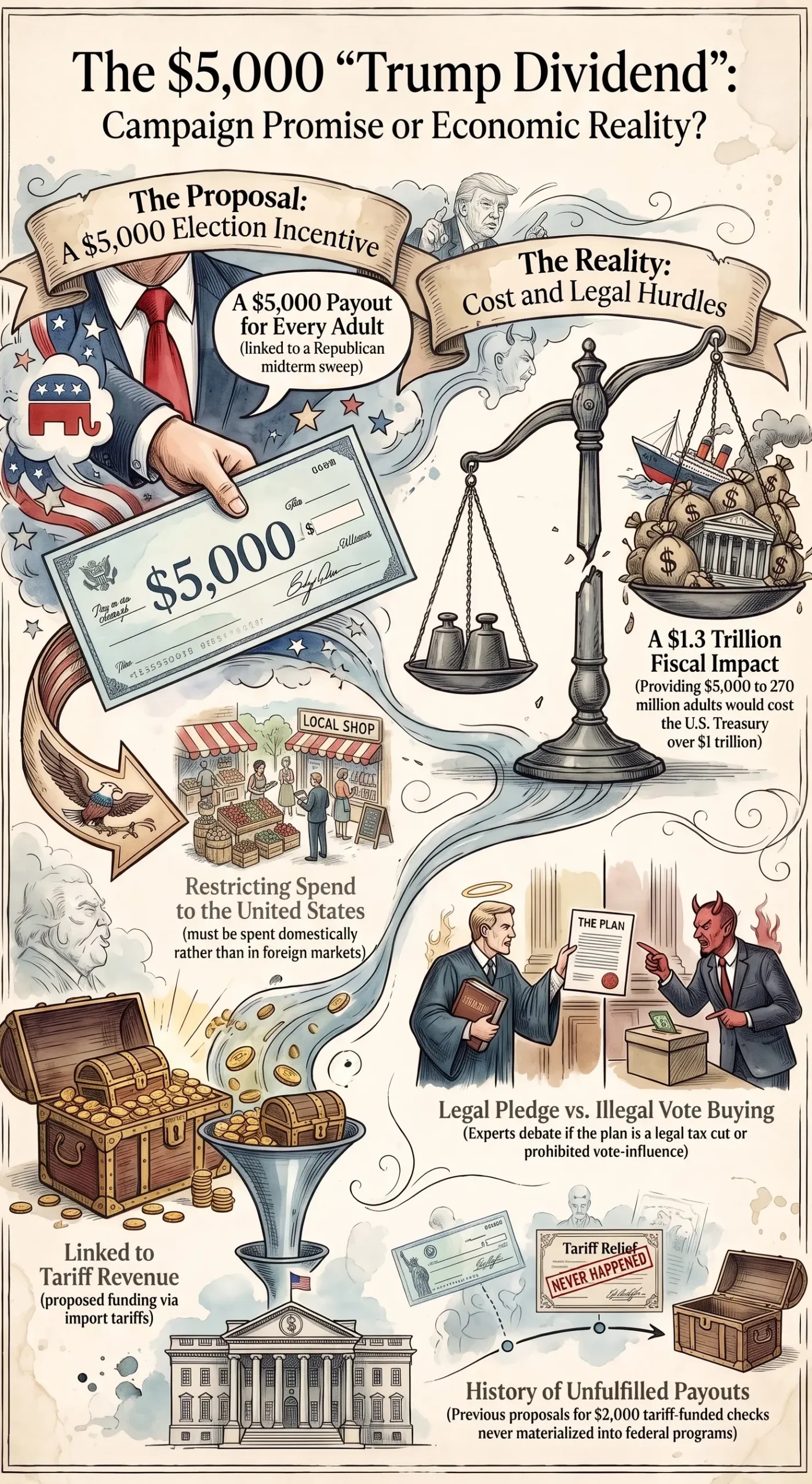
The financial calculation behind the proposal is enormous. If approximately 270 million American adults receive a $5,000 payment, the total government expense would reach around $1.3 trillion.
This makes the proposal one of the largest direct payment ideas ever discussed in American politics.
The Domestic Spending Requirement
The proposal also includes a protectionist condition requiring the money to remain within the U.S. economy.
The idea focuses on encouraging domestic spending while limiting benefits to foreign economies.
How Would Spending Be Controlled?
A major unanswered question is how the government would monitor where citizens spend the money.
Possible systems could include:
- Government-controlled digital payment systems
- Restricted dividend debit cards
- Domestic-only spending mechanisms
However, no detailed enforcement structure has been publicly established.

2. The Tariff Funding Mystery and History
The Proposed Funding Source
A major part of the Trump Dividend argument is that tariff revenue would generate enough funds to support the payment system.
Supporters argue that foreign companies and countries would contribute through tariff payments rather than placing the burden on American taxpayers.
The Major Obstacles Facing the Plan
- Supreme Court Tariff Decision: The administration’s tariff strategy faces legal challenges after court decisions questioning the authority behind certain tariffs.
- The Legislative Challenge: Congress controls government spending, meaning approval would require legislative support.
- Budget Pressure: A $1.3 trillion program would add significant pressure to federal finances.
- Previous Unfulfilled Promises: Earlier discussions around similar payments raise questions about implementation.
3. Geopolitics as an Election Strategy
One of the most controversial aspects of the Trump Dividend is its connection with international events and economic pressure.
The proposal has emerged during a period of energy market uncertainty, including concerns around oil prices and global conflicts.
Economic Pain and Political Messaging
The argument behind the proposal connects current economic difficulties with future financial relief.
This creates a major political question:
Can economic hardship become a reason for voters to support a specific political outcome?
The Risk Behind the Strategy
If voters believe the economic challenges are caused by current leadership, the dividend proposal could face criticism. However, if voters view the difficulties as temporary sacrifices leading toward future benefits, the strategy could gain support.
4. The Legal Debate: Policy Promise or Election Incentive?
The Trump Dividend has created a major legal debate regarding whether it represents a legitimate economic policy or an improper election incentive.
The Argument Supporting Legality
Supporters argue that the dividend is similar to other campaign promises such as tax cuts or economic relief programs.
Their argument is that proposing financial benefits to citizens is part of normal political campaigning.
The Argument Against the Proposal
Critics argue that linking a direct payment to a specific election result creates concerns about voter influence.
The central debate focuses on whether the proposal represents:
- A legitimate economic policy platform
- A financial incentive connected to voting behaviour
5. Breaking the President’s Party Midterm Curse
Historically, the president’s political party often loses support during midterm elections.
The Trump Dividend is viewed by supporters as a strategy that could challenge this traditional pattern by creating a direct financial connection between voters and government policy.
Changing the Midterm Election Dynamic
The proposal attempts to transform the election conversation from traditional political debates into a discussion about direct economic benefits.
Instead of focusing only on ideology, voters are asked to consider the immediate financial impact of the proposed payment.
The Bigger Question: Economic Relief or Political Transformation?
The Trump Dividend represents more than a financial proposal. It raises broader questions about government spending, election strategy, and the relationship between citizens and political promises.
The success or failure of such a proposal depends on multiple factors:
- Economic conditions
- Congressional approval
- Legal challenges
- Public opinion
- Implementation feasibility
Final Thoughts: What Does the Trump Dividend Mean for America?
The $1.3 trillion Trump Dividend remains one of the most debated economic and political proposals because it combines financial relief, election strategy, and government policy into a single idea.
Supporters see it as a way to return economic benefits directly to citizens. Critics question its financial sustainability, legal foundation, and long-term impact.
Ultimately, the proposal raises a larger philosophical question:
Should governments focus on long-term policy solutions, or direct financial benefits that immediately impact citizens?
As the debate continues, the Trump Dividend remains a powerful example of how economics, politics, and public sentiment intersect in modern elections.
Frequently Asked Questions (FAQs)
What is the Trump Dividend?
The Trump Dividend refers to a proposed $5,000 payment for adult American citizens if Republicans gain control of both the House of Representatives and the Senate.
How much would the Trump Dividend cost?
The estimated cost of the proposal is around $1.3 trillion based on payments to approximately 270 million adults.
How would the Trump Dividend be funded?
Supporters have suggested tariff revenue as a potential funding source, although questions remain about legal authority and financial feasibility.
Why is the Trump Dividend controversial?
The proposal is controversial because critics question its funding, legality, implementation process, and connection to election outcomes.
Could Congress approve the Trump Dividend?
Any major government spending program would require congressional approval because the Constitution gives Congress control over federal spending.
Is the Trump Dividend a policy plan or an election strategy?
Supporters describe it as an economic relief proposal, while critics argue that its connection to an election outcome makes it a political strategy.
To understand how federal spending decisions are made and how major government programs are funded, visit the official Congressional Budget Office (CBO) .
For information about federal election laws and campaign regulations, visit the official Federal Election Commission (FEC) .
- FPL 2026/27 Gameweek Strategy: The Complete Guide to Building a Winning Fantasy Team
 FPL 2026/27 Gameweek Strategy: The Complete Guide to Building a Winning Fantasy Premier League Team Fantasy Premier League has transformed from a simple football prediction game into a global competition where millions of managers test their football knowledge, decision-making skills and strategic thinking every week. For some managers, FPL is about supporting their favourite players.…
 - Trump’s $5,000 Promise: The Election Gamble That Could Change America’s Future
 The $1.3 Trillion Vote: Five Surprising Realities Behind the “Trump Dividend” The despair of the besieged electorate resonated throughout the Dallas Convention Center, where economic and geopolitical anxiety shaped the atmosphere. The discussion around rising oil prices, global tensions, and financial pressure created the backdrop for President Donald Trump’s proposed “Trump Dividend“. The proposal suggests…
 - 9 Shocks Hitting Play in 2026, From the NFL in Chaos to the Final Act of the Ronaldo Era
 9 Surprising Realities Reshaping Sports in 2026: From NFL Chaos to Ronaldo’s Final Act Sports in 2026 are entering an era where certainty is disappearing. The old rules, predictable champions, and dominant dynasties that once defined major leagues are being challenged by unexpected contenders, generational transitions, and legendary athletes writing the final chapters of their…
 - Why Men’s Seeds are Crumbling While the WTA Stands Firm at the 2026 US Open
 The “Two-Horse” Trap: Why Men’s Seeds are Crumbling While the WTA Stands Firm at the 2026 US Open The 2026 US Open has descended into a literal bloodbath at the Billie Jean King National Tennis Center. By the time the fourth-round matches were set, a staggering six of the top 10 men’s seeds had already…
 - NFL 2026: The Season That Turned the League Upside Down
 The Year the Earth Shook: Mercenaries, Legacies, and the Tectonic Shift of the 2026 NFL Season The NFL enters the 2026 season not just in transition, but in the midst of a cataclysmic reshaping of its power hierarchy. Veteran analyst Cris Collinsworth didn’t mince words when he labeled the previous year the “most unusual” the…
Leave a Reply