World News | Canada | US-Canada Trade
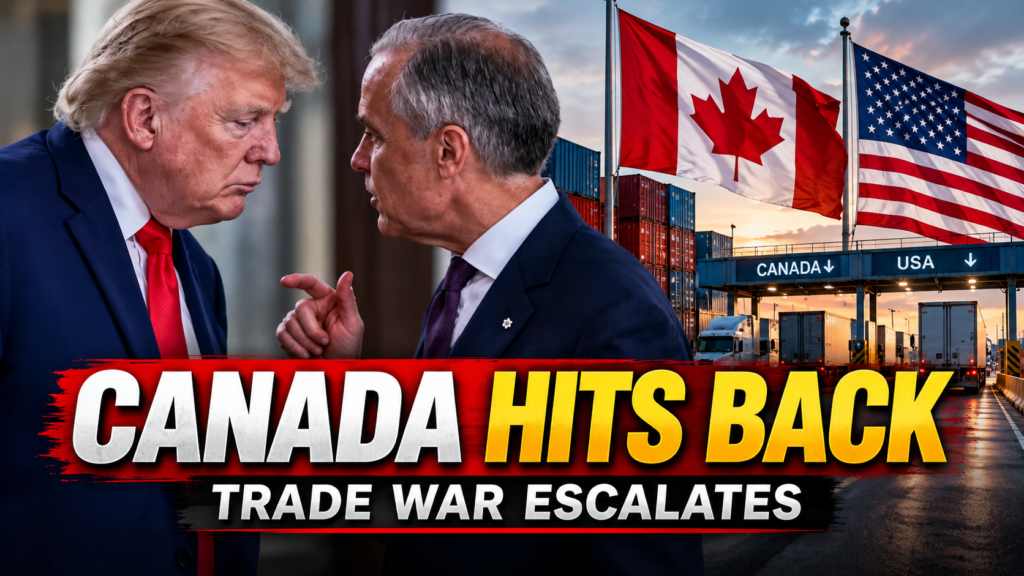
Canada Braces for a Prolonged Trade War as Counter-Tariffs on US Take Effect
Canada has entered a new phase of its trade dispute with the United States, with fresh counter-tariffs now in force on billions of dollars worth of American goods. The move comes as negotiations remain stuck and businesses on both sides of the border prepare for a period of greater uncertainty.
The latest Canadian measures target about C$27.6 billion worth of US imports. Depending on the product, tariffs of 15%, 25% or 50% now apply to selected goods entering Canada.
Ottawa says the measures are a response to US tariffs on Canadian products and are intended to give Canada additional leverage in future negotiations. But the longer the dispute continues, the harder it becomes to separate political pressure from the economic costs being felt by companies and consumers.
The central question is no longer simply whether Canada and the United States can reach a new agreement. It is whether the economic relationship that has connected the two countries for decades can absorb a prolonged period of tariff battles without lasting damage.
Canada’s New Counter-Tariffs Are Now in Force
Canada’s latest tariff package took effect just after midnight on September 8. The measures cover a wide range of American products and represent Ottawa’s latest attempt to respond directly to the US trade actions.
The targeted products include goods connected to industries such as steel and aluminum, appliances, furniture, agricultural equipment, plastics, paper products and electronics.
The rates vary according to the product, with some categories facing tariffs as high as 50%.
The Canadian government has also adjusted portions of the list in response to concerns from domestic industries. That matters because retaliatory tariffs can create unexpected pressure inside the country imposing them.
An importer may face a higher bill at the border, while a manufacturer may suddenly pay more for an American component. A retailer may then have to decide whether to absorb the additional cost or pass part of it on to customers.
The key point: Canada’s latest response is already affecting actual shipments and businesses. It is no longer simply a threat being discussed at negotiating tables.
Why Is Canada Hitting Back?
Canada’s decision comes after another escalation in the US-Canada trade dispute.
Ottawa has argued that it cannot allow American tariffs to remain one-sided without responding. The Canadian government has therefore chosen targeted retaliation while continuing to leave open the possibility of a negotiated settlement.
The strategy is straightforward in theory: make US exporters feel some of the pressure that Canadian businesses are already experiencing.
In practice, however, retaliation is complicated.
Many Canadian companies rely on American products, components and raw materials. Tariffs intended to pressure US exporters can therefore increase costs for Canadian businesses at the same time.
That is the central difficulty facing Ottawa. The government wants to create leverage without causing unnecessary damage to the domestic economy.
The Trade War Involves Two Deeply Connected Economies
Canada and the United States have one of the world’s most deeply integrated economic relationships.
Goods move across the border every day through a network of roads, railways, pipelines, factories, ports and distribution centres. In many industries, products are assembled through supply chains that involve both countries.
Canada remains heavily dependent on the US market for exports. Recent trade data show that the United States continues to account for the majority of Canadian exports, making American market access extremely important to Canadian producers.
That dependence gives Washington significant economic leverage. But the relationship also works in the other direction.
American companies rely on Canadian customers, energy supplies, industrial materials, agricultural inputs and intermediate goods.
This mutual dependence is why the current trade dispute is so difficult to resolve. Neither side can simply walk away without creating costs at home.
How Tariffs Can Reach Consumers
A tariff is collected on an imported product, but that does not mean the importer is always the only one who pays the economic price.
Consider a Canadian retailer importing an American appliance. Once the tariff is applied, the retailer has several choices.
It could absorb the higher cost and accept a smaller profit margin. It could negotiate a lower price with the supplier. Or it could raise the retail price and pass some of the increase to customers.
Different businesses will make different decisions.
Companies with strong margins may absorb more of the cost. Businesses operating on tight margins may have little choice but to raise prices or search for alternative suppliers.
This is why consumers may notice the effects of tariffs unevenly. Some products could become more expensive while others may barely change in price.
Small Businesses Face a Tougher Adjustment
Large companies generally have more options when trade rules change. They may have multiple suppliers, international operations and enough capital to restructure their supply chains.
Smaller businesses may not have that flexibility.
A Canadian company that has relied on a particular American supplier for years may not be able to replace that source immediately. Even when another supplier exists, switching can involve new contracts, higher shipping costs, quality checks and delays.
The uncertainty itself can become a business problem.
A company can plan around a known tariff rate. It is much harder to plan when the tariff could change again after a few weeks or months.
That uncertainty can influence decisions about hiring, investment, inventory and expansion.
The Auto Industry Could Become a Major Flashpoint
Few industries illustrate the risks of a prolonged Canada-US trade war better than automobiles.
North American vehicle production depends on complex supply chains that cross national borders repeatedly. Engines, electronics, metals, glass and other components may be produced in one country and assembled in another.
When tariffs are introduced into that system, costs can accumulate at multiple stages.
The situation could become even more serious if proposed US tariffs on Canadian vehicles and auto parts are implemented at higher rates. That could place additional pressure on Canadian factories and suppliers while also raising costs for American manufacturers that depend on Canadian inputs.
The auto sector therefore sits near the centre of the dispute because it depends so heavily on the very cross-border integration that tariffs can disrupt.
The Trade Conflict Is Expanding Beyond Tariffs
The current dispute is no longer limited to traditional import duties.
New US measures affecting selected Canadian products and government procurement could create additional pressure on Canadian exporters.
That matters because every new restriction broadens the economic impact of the dispute.
Tariffs mainly change the cost of importing a product. Procurement restrictions can affect whether companies are able to compete for government contracts in the first place.
As more sectors become involved, businesses have to spend more time evaluating political risk alongside ordinary commercial decisions.
Canada Wants to Reduce Its Dependence on the US
One of the biggest long-term consequences of the trade dispute could be a change in Canada’s approach to international trade.
Prime Minister Mark Carney’s government has emphasised the importance of economic resilience and strengthening Canada’s relationships with markets outside the United States.
The current dispute has made that strategy more urgent.
Canada can look toward European and Asian markets, expand domestic production and encourage companies to build more diversified supply chains.
But diversification is not a quick replacement for the American market.
The United States is geographically close, economically enormous and deeply integrated with Canadian industry. A Canadian business cannot simply replace decades of US relationships with a new export market overnight.
The realistic goal is therefore not to stop trading with the US. It is to make Canada less dependent on a single market.
Why Diversification Will Take Years
Building new trade relationships sounds straightforward until the practical details are considered.
Exporters need reliable transportation, distribution networks, local partners, regulatory approvals and customers. Factories may need new equipment. Products may need to be redesigned to meet different standards.
All of that requires time and money.
Canada’s existing trade infrastructure has evolved around the American market for generations. Roads, railways and manufacturing hubs are heavily connected to the US economy.
That means diversification should be viewed as a long-term economic strategy rather than a quick escape from the current dispute.
The Canadian Government Is Trying to Cushion the Impact
Ottawa knows that tariffs can hurt Canadian businesses as well as American exporters.
The government has therefore announced support measures intended to help businesses and workers affected by the trade dispute.
The federal government has announced C$7.5 billion in new and enhanced measures, building on previously announced support programmes.
The goal is to give businesses more time to adjust while the tariff dispute continues.
Government support can reduce the immediate pressure, but it cannot completely eliminate the costs created by weaker exports, higher input prices or delayed investment.
Canada’s Trade Data Shows Why the Dispute Matters
Recent Canadian trade data underline the scale of the challenge.
Canada’s trade surplus fell sharply in July, while exports to the United States also declined. That does not mean tariffs alone explain every movement in the data, because commodity prices, global demand and production also affect trade.
Still, the figures illustrate how closely Canada’s economic performance is tied to international trade and especially to the US market.
The longer the dispute continues, the more important it becomes for policymakers to prevent a temporary trade shock from turning into a long-term investment problem.
The US Is Also Exposed to the Fallout
The economic consequences of the trade war do not stop at Canada’s border.
American exporters selling affected products into Canada are now facing higher barriers. Some may have to accept smaller margins, increase prices or search for customers elsewhere.
At the same time, the United States relies on Canada for important supplies, particularly in areas such as energy, industrial materials and agricultural inputs.
That creates a complicated balance.
Washington has the larger economy and therefore greater overall economic leverage. But American industries can still feel the effects of Canadian retaliation when Canadian products or customers are difficult to replace.
Why the Trade War Could Last Longer Than Expected
One of the most worrying signs is the lack of a clear negotiating breakthrough.
When talks stall, tariffs can remain in place long enough for businesses to begin changing their behaviour.
Companies may switch suppliers. Manufacturers may rethink where they produce goods. Investors may delay projects or decide to build new capacity somewhere else.
Those decisions can have effects that last longer than the original dispute.
Once a company spends years rebuilding its supply chain, returning to the old system may no longer make financial sense even after tariffs are removed.
That is one reason prolonged trade wars can be more damaging than short tariff disputes.
The Political Cost of Backing Down
Trade negotiations are rarely only about economics.
Governments also have to consider how any agreement will be received by voters.
A compromise that makes economic sense can still be attacked politically as a concession. That can make both sides reluctant to retreat after publicly taking a hard position.
Once tariffs become linked to national political narratives, finding a compromise can become harder even when businesses on both sides are calling for more predictable trade.
What Happens to USMCA and CUSMA?
Another major issue is the future of the North American trade framework.
Known as USMCA in the United States and CUSMA in Canada, the agreement provides an important framework for trade between Canada, the United States and Mexico.
Continued tariff disputes have raised new questions about how stable that framework will be in the years ahead.
For businesses, the uncertainty is especially important because large investments often depend on predictable trade rules.
A company deciding where to build a factory may be thinking ten or twenty years ahead. If tariff policy can change dramatically from one year to the next, the calculation becomes much more difficult.
Could Canada Eventually Become More Resilient?
The answer could be yes, but the process will take time.
A prolonged dispute could accelerate investment in Canadian manufacturing, infrastructure and alternative export markets.
Businesses that once relied almost entirely on US customers may discover new opportunities elsewhere. Domestic manufacturers could gain customers that previously depended on imported products.
The trade war could therefore encourage a more diversified Canadian economy.
But diversification also carries costs. Some companies may struggle during the transition, and new markets are not guaranteed to replace the volume and convenience of US trade.
Canada may ultimately end up with a more resilient economy, but getting there could involve a difficult period of adjustment.
What Happens Next?
The next major development will likely depend on whether Ottawa and Washington return to serious negotiations.
Canada has already put its latest counter-tariffs into effect, while the United States has announced additional measures affecting selected Canadian products and business opportunities.
That means companies should prepare for the possibility that more changes could follow.
At the same time, neither country has a realistic incentive to completely sever the economic relationship.
Geography matters. Existing infrastructure matters. Supply chains matter. Millions of jobs and billions of dollars in economic activity are connected to cross-border trade.
Those realities create a strong incentive to eventually return to the negotiating table, even if the path there is difficult.
The Bigger Lesson for North American Trade
The Canada-US tariff dispute is demonstrating how quickly political decisions can disrupt even highly integrated economies.
For decades, companies on both sides of the border built their businesses around the assumption that trade rules would remain relatively predictable.
That assumption is now being tested.
Businesses are increasingly thinking about supply-chain resilience, alternative markets and political risk alongside normal commercial planning.
Canada, in particular, is being pushed to reconsider how much of its economic future should depend on its southern neighbour.
The United States, meanwhile, has to weigh the benefits of trade pressure against the costs that can eventually fall on American manufacturers, exporters and consumers.
The dispute may therefore have consequences far beyond the current tariff lists.
Frequently Asked Questions
What counter-tariffs has Canada imposed on the US?
Canada has introduced tariffs of 15%, 25% and 50% on selected US goods. The measures cover approximately C$27.6 billion in imports from the United States.
When did Canada’s latest tariffs take effect?
The latest Canadian counter-tariffs took effect just after midnight on September 8, 2026.
Why is Canada imposing tariffs on American goods?
Canada says the measures are a response to US tariffs on Canadian products and are designed to protect Canadian interests while increasing pressure for future negotiations.
Will Canadian consumers pay more?
Some products could become more expensive if businesses pass tariff-related costs through to customers. The effect will vary depending on the product, supplier and retailer.
Which industries could be affected most?
Highly integrated industries such as manufacturing and automobiles could face significant pressure because products and components frequently cross the Canada-US border during production.
Are American companies also affected?
Yes. US exporters selling affected goods in Canada can face higher costs and reduced competitiveness. Some American businesses may respond by reducing prices, accepting lower margins or finding alternative markets.
What is USMCA?
USMCA is the United States-Mexico-Canada Agreement, known as CUSMA in Canada. It provides the broader framework for much of North American trade.
Can Canada reduce its dependence on the United States?
Canada can diversify its export markets and strengthen domestic production, but replacing the scale, proximity and integration of the US market would take years.
Could the trade war continue for years?
It is possible. The duration will depend on whether the two governments can reach a compromise and how long businesses and consumers are willing to absorb the costs of prolonged uncertainty.
Final Thoughts
Canada’s latest counter-tariffs mark another important moment in a trade dispute that is becoming increasingly difficult to contain.
The measures are designed to send a clear message to Washington: Canada is prepared to retaliate rather than accept growing trade pressure without a response.
But retaliation comes with a price.
Canadian businesses may face higher input costs. US exporters may lose customers. Consumers could pay more for some products. Investment decisions could be delayed. And companies may begin rebuilding supply chains that took decades to create.
The biggest risk may therefore be uncertainty rather than any individual tariff rate.
North American commerce has historically depended on predictable rules and deep economic integration. Every new tariff or trade restriction makes that system a little harder to operate.
Canada is now trying to walk a narrow line: resist US pressure, protect Canadian workers and businesses, diversify the economy and still preserve a relationship with America’s enormous market.
The United States faces its own calculation. Washington has significant economic leverage, but prolonged confrontation can also create higher costs for American companies that rely on Canadian supplies and customers.
For now, the tariffs are in place and negotiations remain uncertain.
The longer that situation continues, the more likely it becomes that today’s temporary trade measures will begin shaping tomorrow’s economic decisions.
The real test for Canada and the United States will not be who can impose the toughest tariff. It will be whether both countries can eventually find a way back to a stable trading relationship without permanently damaging the economic system that has connected them for generations.
Leave a Reply