World News | European Politics | Germany
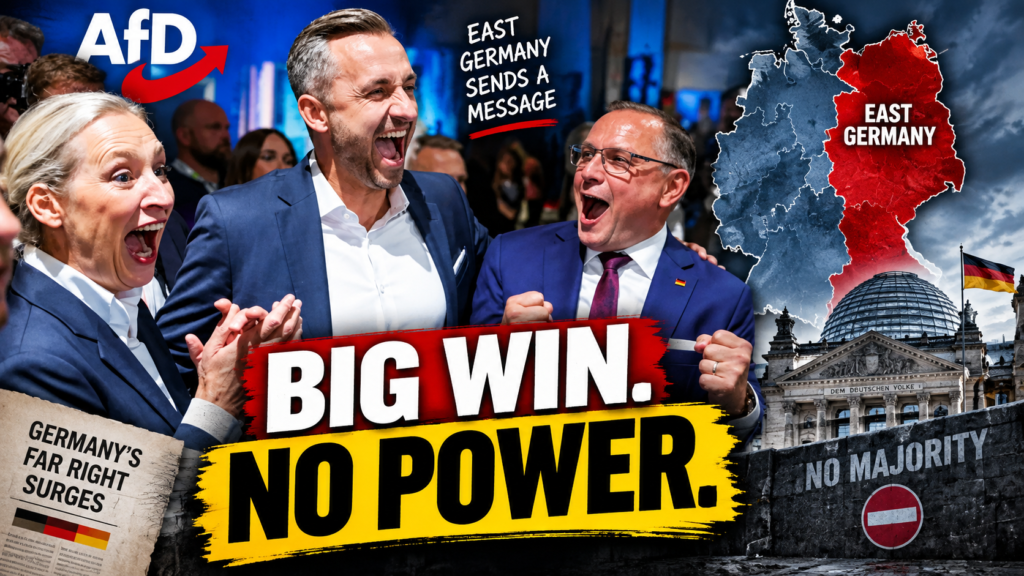
AfD Wins Big in Eastern Germany — So Why Can’t It Take Power?
Germany’s political landscape is becoming increasingly difficult to read through the old divisions of left and right. Nowhere is that more apparent than in the country’s eastern states, where the Alternative for Germany, or AfD, has established itself as a powerful political force.
The party has celebrated major electoral gains in the east as a historic breakthrough. Its supporters see the results as evidence that the political establishment is losing its grip and that voters are increasingly willing to back a party once considered firmly outside Germany’s political mainstream.
Yet there is a striking contradiction at the centre of the AfD’s success.
The party can win big without actually being able to govern.
That is because Germany’s parliamentary system turns electoral victories into a question of numbers, coalitions and political alliances. A party can finish first and still find itself sitting on the opposition benches if it cannot secure the support needed to form a government.
That is the mathematical wall now confronting the AfD.
The AfD’s “Big Victory” Comes With a Major Catch
The AfD has described its performance in eastern Germany as a major victory. From a purely electoral perspective, the claim carries weight. The party’s growing support demonstrates that it has built a formidable base in parts of the former East Germany.
But winning the largest share of the vote is not the same as winning a governing majority.
In a parliamentary democracy, parties generally need enough seats to command a majority or enough coalition partners to build one. That means the final result is not determined solely by which party receives the most votes.
This distinction explains the unusual position of the AfD.
It can be the most successful individual party in a regional contest while remaining unable to control the government. Its electoral strength gives it visibility, influence and a powerful platform, but not necessarily executive power.
The result is a political paradox: a party can win the political argument at the ballot box while losing the coalition mathematics that determines who governs.
Why Eastern Germany Has Become an AfD Stronghold
The geography of the AfD’s success matters.
The party’s strongest support has developed in several eastern German states, where political attitudes can differ significantly from those found in western Germany.
The historical legacy of German reunification remains part of the political backdrop. Economic differences, demographic changes, dissatisfaction with established parties and perceptions of being overlooked by political decision-makers have all contributed to distinctive political dynamics in the region.
The AfD has been particularly effective at turning these frustrations into political messaging.
Its campaign language frequently focuses on immigration, national identity, economic pressure, dissatisfaction with established institutions and opposition to what it portrays as the political consensus of mainstream parties.
That message has resonated with a significant section of voters in parts of eastern Germany.
The result is not simply a temporary protest vote. The AfD has developed a durable political infrastructure in the region, giving it the ability to compete seriously in elections and shape the broader political debate.
The East Has Become a Political Frontier
Germany’s east has increasingly become a political testing ground.
The strength of the AfD in the region demonstrates that Germany’s electorate is not politically uniform. Issues that dominate political discussions in Berlin, Hamburg or other western German centres may not have the same impact in smaller eastern communities.
This regional divide makes the AfD’s gains particularly significant.
A strong performance in the east provides the party with more than parliamentary seats. It gives the AfD a geographical base from which it can attempt to expand its influence nationally.
At the same time, that concentration also creates a limitation.
If the party remains heavily dependent on eastern Germany, it may struggle to translate regional dominance into a nationwide governing majority.
That is the central challenge: regional power is not automatically national power.
Why Winning First Place Does Not Guarantee Government
For voters accustomed to presidential systems, parliamentary coalition politics can be confusing.
In a presidential election, winning the required number of votes can directly determine who takes executive office. Parliamentary systems work differently.
Seats in the legislature determine the balance of power, and parties may need to cooperate with one another to create a governing majority.
That means the party that finishes first can sometimes be unable to form a government.
The AfD’s position is particularly complicated because other mainstream parties have generally been unwilling to treat it as a conventional coalition partner.
As a result, even a major electoral breakthrough can leave the party without a practical route into government.
The AfD therefore faces two separate battles: winning more votes and finding a way to turn those votes into governing power.
The Coalition “Firewall” Around the AfD
This political barrier is sometimes described as a firewall.
The concept is straightforward. Mainstream parties can collectively prevent the AfD from entering government by refusing to form coalitions or provide the parliamentary support necessary for it to take control.
The firewall does not erase the AfD’s electoral support.
Instead, it changes what that support can accomplish.
A party can receive a large percentage of votes and still remain outside government if no other party is willing to cooperate with it.
For the AfD, this creates a particularly difficult strategic problem.
Its outsider identity is one of its strongest political assets. The party can portray itself as an opponent of the established political order. But the same outsider status makes it harder to build the alliances required to govern.
The very political identity that helps attract supporters can therefore become an obstacle to exercising power.
The AfD’s Strategy: Turning a Loss of Power Into a Victory Narrative
Political campaigns are not only about numbers. They are also about narratives.
By describing a major electoral performance as a victory, the AfD can shift public attention away from the question of whether it actually gained the ability to form a government.
This is a deliberate political strategy.
Instead of allowing the conversation to become “the AfD failed to secure a majority,” the party can make the story “the AfD has become one of Germany’s strongest political forces.”
That distinction matters because political momentum can influence future elections.
A party that repeatedly demonstrates strong results can convince supporters that it is moving toward eventual power.
The strategy has several potential benefits:
- Narrative control: Electoral gains can be presented as evidence of an unstoppable political rise.
- Base mobilisation: Supporters are encouraged to see the result as progress rather than disappointment.
- Pressure on rivals: Mainstream parties face questions about how they can exclude a party with substantial electoral support.
- Long-term momentum: Strong regional performances can become a foundation for future national campaigns.
The Majority Threshold Is the Real Test
Behind all the political speeches and election-night celebrations is a simple mathematical reality.
A party needs enough seats to govern.
Without a majority, it needs partners.
And without partners, electoral popularity has limits.
This is why the AfD’s eastern surge is simultaneously impressive and incomplete.
The party has demonstrated that it can attract a large electorate. But the next stage is much more difficult: transforming that support into a coalition capable of controlling a government.
If mainstream parties continue refusing cooperation, the AfD may need to win substantially more support before it can realistically cross that barrier on its own.
That makes every future election a test of whether the party can expand beyond its strongest eastern bases.
Why the AfD’s Eastern Success Matters Nationally
Even if the AfD remains outside government, its electoral strength can still reshape German politics.
Mainstream parties must respond when a challenger consistently wins a significant share of the vote.
They may change their policies, adjust their campaign strategies or attempt to address issues that are driving voters toward the AfD.
That can influence debates far beyond the regions where the AfD is strongest.
Immigration, economic insecurity, national identity, energy policy and dissatisfaction with political institutions can become increasingly central to national political discussions.
The AfD therefore does not need to enter government to influence the direction of German politics.
Its presence alone can change what other parties discuss and how they campaign.
The AfD’s Biggest Challenge May Be Expanding Beyond the East
The question now is whether the AfD can turn eastern strength into a genuinely nationwide political coalition.
Regional dominance gives the party a strong foundation, but Germany’s electoral geography is much larger than the eastern states where it performs particularly well.
To become a governing force, the AfD would need to convince substantially more voters across other parts of Germany.
That presents a strategic dilemma.
The party’s strongest messaging may be particularly effective among voters who already feel alienated from the political mainstream. But expanding into areas where those messages are less popular could require a broader political appeal.
The AfD therefore faces a difficult balancing act: maintaining the identity that built its core support while simultaneously becoming attractive to voters outside that base.
Why Other Parties Remain So Important
The AfD’s future cannot be understood simply by looking at its own vote share.
The positions of Germany’s other parties are equally important.
If mainstream parties continue to reject cooperation with the AfD, the party’s route into government remains extremely difficult even when its electoral performance improves.
But political systems can change.
Pressure from voters, changes in party leadership, shifting public opinion and future election results can all influence coalition calculations.
That is why each new AfD breakthrough creates a larger political question.
How long can the established parties maintain the firewall if the AfD continues to increase its support?
The Political Meaning of a “Powerless” Victory
The AfD’s eastern surge demonstrates an important feature of modern European politics: political influence and formal government power are not always the same thing.
A party can dominate headlines, force rivals to respond to its agenda and attract millions of voters without controlling the executive branch.
That is the current paradox surrounding the AfD.
Its victories are real in the sense that they demonstrate substantial electoral support. But the party’s inability to secure a majority or reliable coalition partners limits what it can actually accomplish through government.
This is why the phrase “big victory” requires context.
The AfD may have won a major political battle, but the larger war for governing power is far from over.
What Happens Next for the AfD?
Several paths are possible.
The party could continue strengthening its eastern strongholds while attempting to expand in western Germany. It could focus on turning regional victories into a larger national vote share. Or it could attempt to moderate certain positions in order to become more acceptable to potential coalition partners.
Each strategy comes with risks.
Moving toward the political mainstream could alienate some of the voters who support the party precisely because it presents itself as an outsider.
Remaining firmly on the political fringe could preserve its identity but make coalition government even more difficult.
The AfD therefore faces a strategic choice that many successful protest movements eventually encounter:
Does it remain the powerful outsider, or does it attempt to become a governing party?
The answer could define the next chapter of German politics.
Germany’s Political Future Is Still Uncertain
The rise of the AfD in eastern Germany is not an isolated development. It reflects broader changes in European politics, where established parties are facing increasingly strong challenges from populist and far-right movements.
But Germany’s political system contains significant institutional and coalition barriers.
The AfD can continue gaining votes without immediately gaining government power.
That creates a complicated political landscape in which election results can send one message while coalition mathematics sends another.
For now, the firewall remains one of the most important factors limiting the AfD’s ability to convert electoral success into executive authority.
But political firewalls are maintained by political decisions. If voter behaviour changes significantly, the calculations of other parties could eventually change as well.
Frequently Asked Questions
What is the AfD?
The Alternative for Germany, commonly known as the AfD, is a German political party that has become a major force on the country’s right-wing and far-right political spectrum.
Why is the AfD particularly strong in eastern Germany?
The AfD has developed particularly strong support in several eastern German states. Political dissatisfaction, regional economic concerns, demographic changes and debates over immigration and national identity have contributed to its appeal in parts of the region.
Can the AfD govern Germany if it wins an election?
Winning the largest vote share does not automatically guarantee control of government. In Germany’s parliamentary system, a party generally needs a majority or sufficient coalition support to govern.
What is the firewall against the AfD?
The term “firewall” refers to the refusal by other mainstream parties to cooperate with the AfD in forming governments or coalitions. This can prevent the AfD from turning strong election results into governing power.
Why does the AfD call its results a major victory?
Strong election results demonstrate growing support and can strengthen the party’s political momentum. Presenting the result as a victory also allows the AfD to emphasise its growth rather than its inability to form a government.
Does the AfD need a majority to govern?
Not necessarily. A party without an outright majority can govern if it can form a coalition or otherwise secure sufficient parliamentary support. The difficulty for the AfD is that other major parties have generally resisted cooperating with it.
Could the AfD eventually enter government?
Its future role depends on election results, public opinion and the positions of other German parties. A substantial increase in support could alter coalition calculations, but strong regional results alone do not guarantee government participation.
What does the AfD’s eastern surge mean for Germany?
It demonstrates the growing strength of the far right in parts of the country and puts pressure on mainstream parties to respond to voters who are dissatisfied with the existing political order.
Final Thoughts
The AfD’s rise in eastern Germany presents Germany with a political paradox.
The party can celebrate a major electoral breakthrough while remaining far from the centre of government.
Its strength is undeniable: it has built a powerful regional base, attracted substantial support and forced mainstream parties to confront a political challenge that is no longer easy to dismiss.
But elections are ultimately governed by numbers.
Without a majority, a party needs partners. Without partners, even a major victory can leave it on the outside.
That is the mathematical wall facing the AfD today.
The bigger question is whether that wall can hold indefinitely.
If the AfD continues expanding its support beyond its eastern strongholds, Germany’s political calculations could become increasingly difficult. If it remains concentrated regionally, its victories may continue to be powerful symbols without producing national governing power.
For now, the AfD has shown that it can win big.
The harder question is whether it can ever turn that victory into power.
Leave a Reply