World News | Middle East | Military
“`The Bahrain Admission: 5 Surprising Realities of the U.S.-Iran Escalation
Reports of extensive damage to a major U.S. military hub in Bahrain have raised fresh questions about American military strategy in the Persian Gulf.
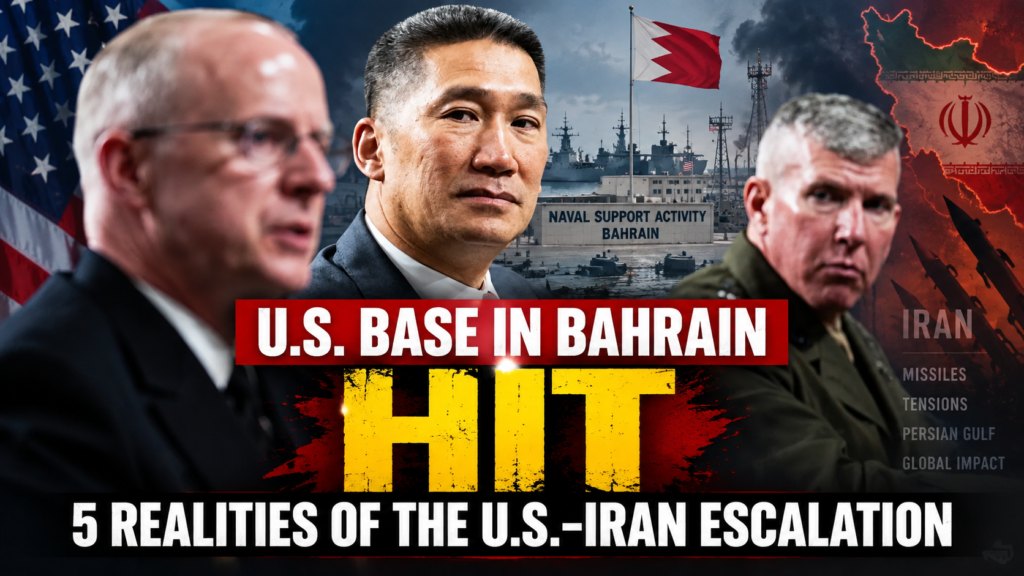
Naval Support Activity Bahrain has long supported the U.S. military presence in the region. The facility is closely linked to U.S. naval operations and the headquarters of the U.S. Fifth Fleet.
The latest confrontation has put that infrastructure under renewed scrutiny. The supplied source material says Acting Navy Secretary Hung Cao publicly acknowledged the seriousness of the damage in unusually direct language.
The issue goes beyond one military installation. Damage to a regional hub can affect ships, aircraft, personnel, logistics and command operations. It can also force military planners to reconsider how much they rely on fixed bases in areas exposed to missile and drone attacks.
Here are five key realities highlighted by the reported developments.
“`1. The Bahrain Admission Changes the Conversation
“`Military officials normally use measured language when discussing damage to strategic facilities. Descriptions often focus on whether operations can continue and how quickly repairs can restore damaged infrastructure.
That makes the reported comments attributed to Acting Navy Secretary Hung Cao notable.
According to the supplied source material, Cao described the scale of the damage in unusually blunt terms, saying: “They blew the hell out of Bahrain.”
The significance of the statement is not only its wording. It is the apparent acknowledgement that the damage was serious enough to affect the U.S. military position in Bahrain.
Naval Support Activity Bahrain is an important part of the American military network in the Gulf. The installation supports naval activity in a region where maritime routes, energy infrastructure and military operations are closely connected.
Damage to such a facility can therefore create effects beyond the physical destruction of buildings or equipment. It can complicate logistics, force personnel to relocate and reduce the usefulness of a familiar regional support network.
Why it matters: The reported damage is significant because Bahrain represents a long-standing American military and logistical presence in one of the world’s most strategically important regions.
2. The USS Abraham Lincoln Faced a Major Logistical Challenge
“`The supplied material also highlights the USS Abraham Lincoln and the logistical difficulties created when access to Bahrain became unavailable.
An aircraft carrier is a powerful military platform, but its effectiveness depends on a much larger support system. Ships need fuel, food, maintenance, spare parts, medical facilities and safe opportunities for crews to rest.
Ports are therefore an important part of carrier operations.
According to the supplied material, the Lincoln had completed a demanding deployment and needed suitable facilities for the ship and its crew. The loss of normal access to Bahrain created an additional logistical burden.
The source describes the carrier as effectively “homeless” and says it eventually docked at Laem Chabang in Thailand.
The episode illustrates a basic reality of modern military operations: advanced weapons platforms still depend on physical infrastructure.
A carrier may operate far from shore for long periods, but it eventually requires maintenance, replenishment and crew support. A disruption at one regional facility can therefore create problems across the wider deployment network.
The supplied source also describes concerns raised by sailors’ families about food, water, plumbing and mental-health pressures aboard the ship. Those accounts were reportedly disputed by Defense Secretary Pete Hegseth, who described the reporting as misrepresented.
The broader lesson is clear. When a major support facility becomes unavailable, the impact can quickly move from infrastructure to personnel and operations.
“`3. The Future of the Fifth Fleet Headquarters Is Now a Question
“`One of the biggest strategic questions concerns the future of the U.S. Fifth Fleet’s presence in Bahrain.
Bahrain has hosted important American military facilities for decades. Its location gives U.S. forces access to the Persian Gulf and surrounding waters.
That geography is valuable, but it also creates a vulnerability. A fixed installation can become a high-value target when an opponent has the ability to launch missiles or drones against it.
The supplied material cites comments attributed to Admiral Daryl Caudle during an August 31 town hall. According to the source, he told displaced personnel that the Navy would not return to the facility anytime soon.
If the disruption lasts, U.S. planners could face several choices.
Washington could rebuild and reinforce existing facilities. It could also distribute command and logistics functions across several locations. Another option would be to move major elements of the Fifth Fleet headquarters structure to a different site.
Each approach would involve trade-offs.
Rebuilding in Bahrain would preserve an established network, but the geographic vulnerability would remain. Dispersing facilities could make it harder for an adversary to disable the wider command structure with one attack, although it would add logistical complexity.
Moving important functions farther from the Gulf could improve survivability while making rapid access to the region more difficult.
That tension sits at the heart of the strategic problem created by a damaged military hub.
“`4. The Jordan Strike Highlights the Cost of Missile Defence
“`Bahrain was not the only location discussed in the supplied material.
The source also describes a reported Iranian strike involving Muwaffaq Salti Air Base in Jordan. The account says several American aircraft were damaged during the engagement.
According to the supplied material, an A-10 Thunderbolt II suffered severe damage, including the loss of a wing, while approximately eight F-15 aircraft sustained lighter damage.
The report also focuses on the use of Patriot interceptors.
The supplied article says U.S. forces fired more than 30 Patriot missiles during the engagement. Using an estimated cost of about $4 million per interceptor would put the reported expenditure above $120 million.
The exact cost of a Patriot interceptor can vary by missile version, contract and accounting method. The broader issue, however, is easier to understand.
Modern missile defence can be expensive. A relatively inexpensive incoming weapon can force a defender to use a sophisticated interceptor that costs considerably more.
That does not make missile defence ineffective. Interceptors can protect personnel, aircraft and critical infrastructure from potentially devastating attacks.
The problem appears when the exchange is repeated over a long conflict. A defender may face significant financial pressure if an opponent can sustain large numbers of missile or drone launches.
“`5. Bahrain’s Location Makes the Stakes Much Bigger
“`The strategic importance of Bahrain is closely tied to geography.
The Persian Gulf sits beside major energy infrastructure, while the Strait of Hormuz remains one of the world’s most important maritime chokepoints.
The U.S. Fifth Fleet has historically supported American naval operations and maritime security across the region.
Any major disruption to that presence can therefore attract attention well beyond military circles.
Shipping companies, insurers, energy traders and governments all watch developments around the Gulf. Higher security risks can increase insurance costs and complicate commercial shipping.
A prolonged disruption could also affect energy markets and wider supply chains.
The supplied material describes additional activity by Iran-aligned groups in other parts of the region, including the Red Sea, and points to continuing pressure on commercial shipping.
These developments show how quickly a confrontation involving Iran and the United States can become a wider regional security issue.
“`The Bigger Question: Can Fixed Military Bases Survive the Missile Age?
“`The most important lesson may not concern Bahrain alone.
Modern precision weapons are changing the military value of geography.
For decades, the United States has benefited from large overseas bases that provide fuel, ammunition, maintenance, accommodation, medical support and command facilities.
Those advantages remain important. At the same time, the same infrastructure can become an attractive target.
Ballistic missiles, cruise missiles and drones give adversaries more ways to threaten fixed installations.
An opponent does not necessarily have to destroy every aircraft or ship. Damaging the infrastructure that supports those assets can also reduce their operational effectiveness.
That is why military planners increasingly consider dispersal, mobility, hardened facilities, deception and rapid relocation.
The goal is to prevent one location from becoming a single point of failure for an entire military operation.
“`What the Bahrain Situation Could Mean for U.S. Strategy
“`If the reported damage proves extensive and long-lasting, Washington may need to reconsider how it organises military power in the Gulf.
One possible response would involve greater reliance on mobile forces that are harder to target. Aircraft, ships and support personnel could operate from a wider network of facilities rather than depending heavily on one regional hub.
Another approach would involve additional investment in missile defence and hardened infrastructure.
Neither option is inexpensive.
The strategic challenge is therefore larger than simply building stronger defences. Military planners must decide how much to invest in protecting fixed facilities when an adversary can continue targeting them.
That calculation becomes more difficult during a prolonged conflict, especially when missile and drone attacks can occur repeatedly.
“`Why the Situation Matters for the Global Economy
“`Military events in the Gulf can quickly produce economic consequences.
The region plays a central role in global energy markets. Any serious threat to shipping can affect freight rates, insurance premiums and commodity prices.
Businesses far removed from the U.S.-Iran confrontation can still feel the effects if energy or transportation costs increase.
Governments may also face additional costs when they deploy naval forces to protect commercial shipping.
A prolonged confrontation could create a wider chain of effects. Military attacks can increase security concerns. Those concerns can raise shipping risks, which can increase insurance and transportation costs.
Some of those higher costs can eventually reach businesses and consumers.
The scale of the economic impact would depend heavily on how long the disruption lasts. A short crisis could create temporary market volatility, while a prolonged conflict could produce deeper economic consequences.
“`What Happens Next?
“`The next phase will depend on the intensity of the U.S.-Iran confrontation and the ability of American forces to restore operational flexibility in the region.
U.S. planners will need to assess damaged facilities, alternative ports and airfields, missile-defence capacity and the vulnerability of other regional installations.
Iran, meanwhile, will have an interest in identifying weaknesses in the American military network.
The result could become a test of endurance rather than a single exchange of attacks.
If U.S. forces can disperse vulnerable assets and maintain maritime operations, the disruption in Bahrain could become a difficult but manageable episode.
If more bases or supply routes come under pressure, the strategic consequences could become much larger.
“`Frequently Asked Questions
“`What is Naval Support Activity Bahrain?
Naval Support Activity Bahrain is a major U.S. Navy installation in Bahrain. It supports American naval operations in the Middle East and is associated with U.S. Naval Forces Central Command and the Fifth Fleet.
What happened to the U.S. base in Bahrain?
The supplied source material reports extensive damage to U.S. facilities in Bahrain following Iranian attacks. It also says Acting Navy Secretary Hung Cao acknowledged the seriousness of the damage.
Who is Hung Cao?
Hung Cao is a retired U.S. Navy officer who served as Acting Secretary of the Navy. The supplied material attributes comments about the Bahrain damage to him.
What happened to the USS Abraham Lincoln?
According to the supplied material, the USS Abraham Lincoln faced a logistical challenge after losing access to Bahrain and eventually docked at Laem Chabang in Thailand.
Why is Bahrain strategically important to the United States?
Bahrain gives the U.S. Navy access to the Persian Gulf and surrounding waters. The country has hosted important American naval facilities for decades.
What happened at Muwaffaq Salti Air Base?
The supplied material reports that Iranian missiles damaged several American aircraft at the Jordanian base, including an A-10 and multiple F-15s.
Why are Patriot missiles expensive?
Patriot interceptors are sophisticated guided weapons designed to detect and destroy incoming threats. Their cost reflects the technology and systems required for missile detection, tracking and interception.
Could the Fifth Fleet leave Bahrain permanently?
The supplied material identifies relocation as one possible option. It does not establish that a permanent move has been decided. Any such decision would have significant operational and political consequences.
“`Final Thoughts
“`The reported damage in Bahrain raises a difficult question for American military planners: what happens when infrastructure built to support regional power projection becomes a major target?
The answer will not depend on one missile interception or one damaged facility.
It will depend on whether the United States can maintain naval and air operations while adapting its logistics, defences and command structure to a more dangerous environment.
The Bahrain episode also highlights the changing economics of modern warfare. Precision weapons can place pressure on expensive military infrastructure, while defending against repeated attacks can require an equally costly response.
For the Gulf, the stakes are even higher because military instability can affect commercial shipping and energy markets.
The immediate question is whether the reported damage can be contained and repaired. The larger question is whether America’s long-standing military footprint in the region can remain effective in an environment increasingly shaped by missiles and drones.
If the developments described in the source material lead Washington to disperse its forces, rethink fixed bases and invest more heavily in mobile operations, the consequences could extend far beyond Bahrain.
The Gulf could enter a period in which military power depends less on maintaining one large permanent base and more on the ability to survive an attack, relocate quickly and continue operating.
“`
Leave a Reply